PixiJS graphic editor
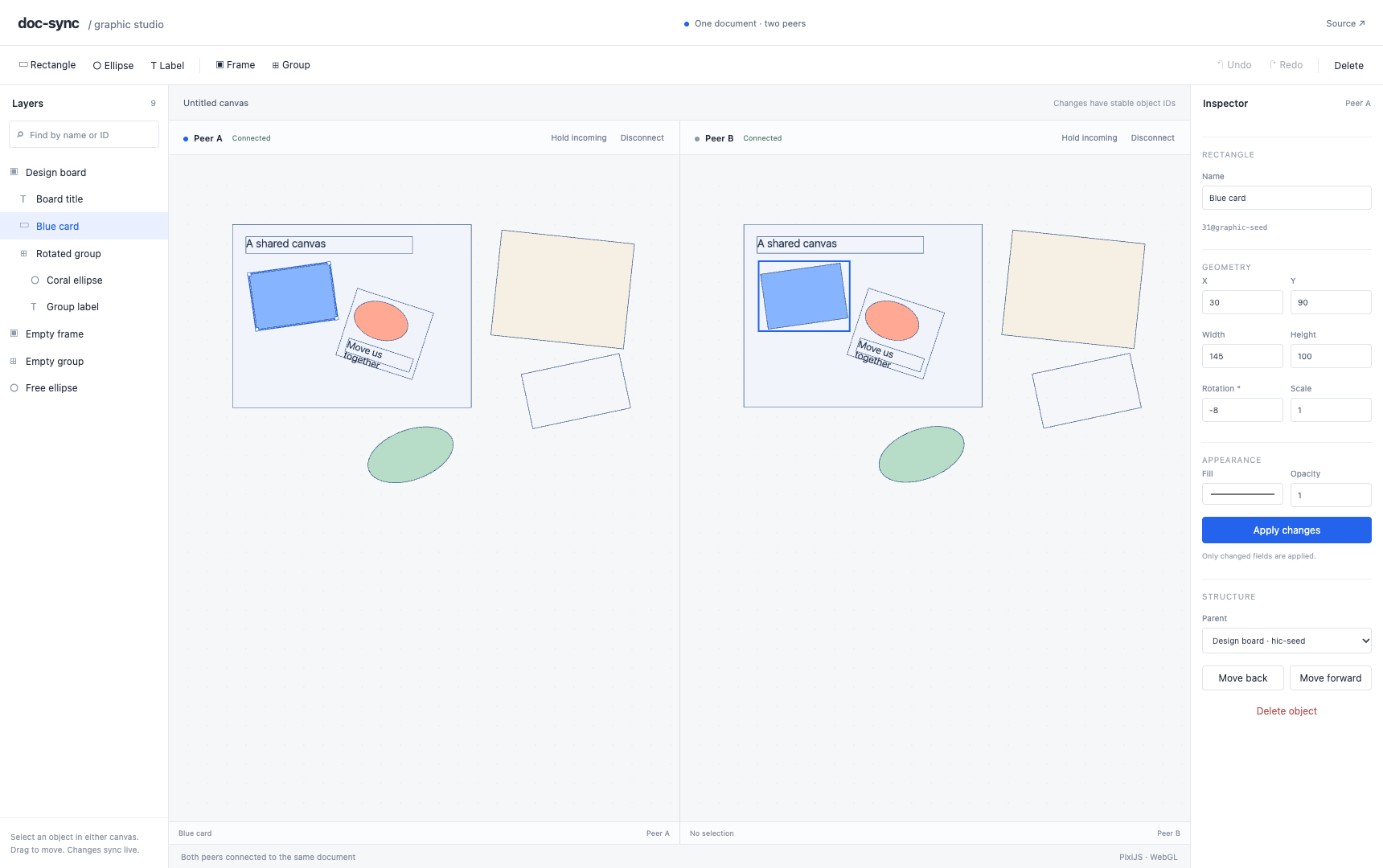
Run the graphic schema in two independent browser clients connected to one local document server. PixiJS renders the scene and handles pointer input. Doc-sync owns the objects, collaboration, and History.
Run the demo
From the repository root with Node 24:
npm ci
npm run dev:graphic
Open the loopback address printed by the server. The default port is 5420. Use GRAPHIC_PORT=0 npm run dev:graphic for an assigned port. A page contains Peer A and Peer B, each with a distinct actor, Client, History, and HTTP/SSE connection. Another page with the same ?doc=canvas joins the same document.
The demo server keeps rooms in memory. Confirmed changes survive a browser view reconnecting while that server process remains alive. Server restart durability and refresh recovery for unconfirmed browser input are not provided by this demo. It uses neither the existing demo data folder nor production credentials.
Try collaboration
- Select a shape in either canvas. The other peer shows its selection.
- Drag it. The preview is local; pointer release commits one edit.
- Change a name, position, size, rotation, scale, color, or label text in the inspector. Only changed fields are submitted.
- Choose another frame or group in Parent. Reparenting keeps the object's canvas transform when the resulting local transform fits the schema bounds.
- Use Hold incoming on both peers, edit different fields, then release both queues. This creates controlled concurrent changes over the real transport.
- Undo one peer's edit and check that the other peer's field remains.
- Disconnect a peer, edit both views, then reconnect it. Pending input is retained in that live client and the views converge.
Resize through the inspector. Corner markers indicate selection; they are not drag-resize controls.
Frames clip children when clipContent is true. Reparenting an object while preserving its world position can place it outside a clipping frame. The object remains in the document and Layers, even when the frame clips its pixels.
Schema design
The demo profile is fixtures/graphic-canvas-schema.ts. It predates the built-in createGraphicSchema() contract. The demo renderer does not consume that larger contract. Paths, gradient/image paints, components, overrides, Boolean source records and general affine transforms are not rendered by this demo.
The application schema is fixtures/graphic-canvas-schema.ts. It is a separate example from the minimal core graphic test fixture. It adds no npm package or new CRDT engine. See Document and graphic schemas.
| Node | Shape | Meaning |
|---|---|---|
canvas | container | Empty-capable root; camera and viewport remain local view state. |
frame | container | Stored objects with an editable box and optional clipping. |
object-group | container | Stored parent with a shared transform and an explicit guide box. |
rectangle, ellipse | atom | Geometric leaves. |
label | text | Plain editable label stored as text runs. |
The label renderer is plain text; this example declares no rich-text marks. Stored groups are not the document domain's computed group shape. An empty frame or group has a visible guide without storing a placeholder child.
| Property | Contract |
|---|---|
name | Display text, at most 120 characters; it is not identity. |
transform | Independent x, y, rotation, and scale fields. Rotation is clockwise screen degrees; scale is positive and uniform. |
size | Independent width and height fields. Group size is an explicit guide box, not a computed union of children. |
fill, stroke | Six-digit hexadecimal colors. Label fill controls its text color. |
opacity | A finite value from zero to one. |
locked | Demo tool behavior; it does not grant or revoke server authority. |
Local x/y bounds are ±1,000,000; scale bounds are 0.001–1,000; dimensions are 1–100,000. Nested world transforms can exceed local bounds. The geometry adapter rejects non-finite, singular, or out-of-range reparent results before writing. Uniform scale keeps the reparent transform representable without skew. Reflection, non-uniform scale, constraints, and Figma-style layout rules are outside this demo.
Field registers allow a peer's color or rotation update to survive another peer's x/y drag and selective undo. Reparent writes the required local transform and structural move in one edit batch. Label changes use a minimal UTF-16-safe splice, retaining unchanged character IDs. A stale inspector text form is rejected rather than replacing an already changed label.
Find objects by ID
Use Find by name or ID in Layers. Names may repeat. Stored CRDT marker IDs identify objects within the document and remain stable through movement and undo.
apps/demo/graphic/session.ts provides the demo adapter's SceneSession.lookup, update, delete, and reparent methods. Its revision-cached Map resolves an ID against the current visible projection before compiling a numeric-path edit. A missing or hidden ID returns no object; editing it fails without selecting a different array position. A new peer insertion, reparent, or sibling reorder invalidates the path index. Presence alone does not rebuild it.
The demo uses the TypeScript SyncClient document compatibility surface for its ID index. A local-only mode and an engine-independent canvas binding are not provided by this adapter.
This is a demo adapter API. The core API does not gain a getNode(id) or PixiJS binding export. PixiJS is a dependency of the private demo workspace; the library packages retain their existing dependency boundaries.
Verify and measure
With the server running:
GRAPHIC_URL=http://127.0.0.1:5420 npm run check:graphic
GRAPHIC_URL=http://127.0.0.1:5420 npm run bench:graphic
The Chrome proof uses trusted canvas and inspector input, exact ID lookup, controlled concurrency, per-actor undo/redo, reparenting, reconnect, and an independent server-model check. It also checks the actual Pixi label projection.
The performance script creates separate sample/100/1,000/5,000-object rooms. Each size has three warmups and ten recorded edits. It separates 1,000 cached ID lookups, synchronous client editing, index rebuilding, Pixi update CPU work, and remote convergence. Full-model equality is checked outside the timed convergence loop. Animation-frame wait is a scheduling measurement, not GPU completion or physical display latency.
Large scenes still have substantial full-document staging and model costs. Correct convergence does not establish interactive performance. Read the current verification report and HANDOFF before choosing a scene-size target. The server permits at most sixteen rooms and never resets an existing room to run a benchmark.