CAD Interop: retain native source and own target display objects
Use the neutral loader to preserve complete native data and derive bounded previews. Use a target adapter when the application already owns a Three, Babylon or Pixi3D scene. The adapter owns its loaded objects/resources; the application keeps its renderer, camera, scene and unrelated objects.
Read a complete evaluated Loft result
Use Loft graph ingestion for a complete evaluated Graph or a complete next Graph with its update transaction. These CPU readers preserve native data and return independent reports. The section edit example supplies the complete original authoring input. A source preview and an evaluated graph have different input roles.
Parse complete source and derive a preview
Use a TypeScript-capable bundler with the workspace @barocss/cad-interop and CAD dependencies. This complete Source0 input contains a Surface and a Curve with a nonunit knot domain.
import { parseBaroCadSource, BaroCadSourceError } from '@barocss/cad-interop/native';
import type { BaroCadParseOptions } from '@barocss/cad-interop/native';

const source = `@model panel_demo {
  version: 0; length-unit: mm;
  @surface #panel {
    type: nurbs; degree-u: 1; degree-v: 1;
    knots-u: [0,0,1,1]; knots-v: [0,0,1,1];
    control-points: [[[0,0,0],[0,0,40]],[[100,0,0],[100,0,40]]];
    weights: [[1,1],[1,1]];
  }
  @curve #edge {
    type: nurbs; degree: 1; knots: [-3,-3,7,7];
    control-points: [[0,0,0],[100,0,0]]; weights: [1,1];
  }
}`;
const options: BaroCadParseOptions = {
  sourceVersion: 0, countU: 3, countV: 3, unitsPerMillimeter: 0.001,
  nativeCapacity: { version: 1, maximumObjects: 16 },
  curveDisplay: { version: 1, chordToleranceMM: 0.1, maxSegments: 64, maxDepth: 8 },
};
let accepted = parseBaroCadSource(source, options);
console.log(accepted.model.name); // panel_demo.
console.log(accepted.surfaces.map(surface => surface.surfaceId)); // ['panel'].
console.log(accepted.curves.map(curve => curve.curveId)); // ['edge'].
function applySource(text: string) {
  try { accepted = parseBaroCadSource(text, options); }
  catch (error) {
    if (error instanceof BaroCadSourceError) console.error(error.diagnostics);
    else throw error;
  }
}
source retains complete original text and model retains original coefficients/IDs. The 3×3 Surface preview contains9 XYZ vertices and 8 triangles. Native width 100 mm becomes 0.1 display unit at the declared scale. Curve samples retain original parameters in [-3,7]; they are not normalized texture coordinates. Without explicit Curve display options, the native Curve stays in the Model but has no derived display line.
Assignment happens only after successful parsing. A refused candidate leaves the host's accepted result intact. Neutral results are copied CPU data and have no target renderer to dispose. Preview buffers are derived approximations, not replacement native authoring.
Add a loaded Group to a caller-owned Three scene
The /three entry requires the compatible Three peer (^0.186.1 in this package profile). The application supplies the Scene, camera and renderer through its ordinary browser bundler. Use the full source and options above:
import { Scene, PerspectiveCamera, WebGLRenderer } from 'three';
import { BaroCADLoader } from '@barocss/cad-interop/three';

const scene = new Scene();
const camera = new PerspectiveCamera(45, 640 / 360, 0.001, 10);
camera.position.set(0.2, 0.15, 0.2);
camera.lookAt(0.05, 0, 0.02);
const renderer = new WebGLRenderer();
renderer.setSize(640, 360);
document.body.append(renderer.domElement);
const loader = new BaroCADLoader(options);
const loaded = loader.parse(source);
scene.add(loaded.group);
renderer.render(scene, camera);
// When this model closes: loaded.dispose().
// When the application closes: renderer.dispose() and remove its canvas.
The Group contains the original Surface Mesh and the requested Curve Line, with names panel and edge. The native Model still contains both objects. Surface _CAD_UV data contains native parameters rather than texture UVs. Target picking on a sampled line/triangle is a display query, not an exact native intersection.
For replacement, parse the candidate before removing the accepted Group. Keep the old result if parsing/admission fails. On success, attach the candidate and dispose the previous result at your host's presentation boundary. loaded.dispose() removes its Group and releases owned geometry/materials; it does not destroy your Scene, camera, renderer or unrelated objects.
Load a URL with caller-owned cancellation
import { loadBaroCadSource, BaroCadLoadAbortError } from '@barocss/cad-interop/native';
const controller = new AbortController();
try {
  const loaded = await loadBaroCadSource('/part.barocad', options, { signal: controller.signal });
  console.log(loaded.model.name);
} catch (error) {
  if (!(error instanceof BaroCadLoadAbortError)) throw error;
}
// On cancellation or document close: controller.abort().
The host serves complete Source0 text at its URL and owns selection, cancellation and stale-response decisions. Transport success is not native admission; both must succeed before replacing accepted content. Choosing a different target requires that target's public adapter and supported peer/basis, not a cast of the Three result.
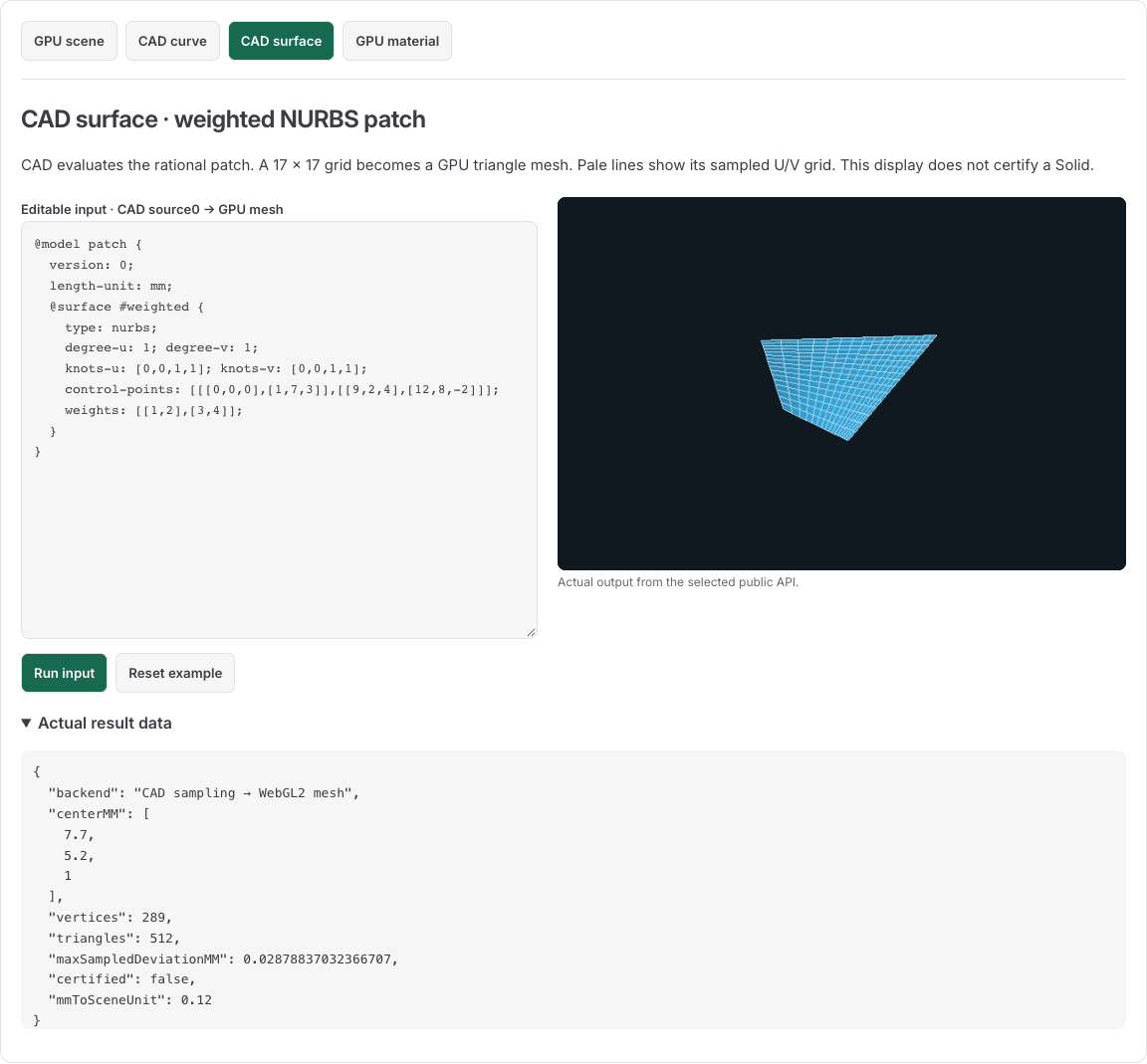
The CAD Surface example shows original source beside a derived GPU mesh. This picture illustrates model/mesh/image roles; it uses a different Surface and render path from the Three example above. It is not a Three, Babylon, Pixi3D or exported-file result.