Schema-driven block operations
Blocks have positions. Use doc.edit() for blocks and text. The at path selects a place in the tree returned by doc.toJSON(). The operation selects the action: insert, delete, update, split, or merge.
| Action | Operation |
|---|---|
| Insert a block at root index 1 | {op: "insert", at: [1], content: [{type: "divider"}]} |
| Change that block's attributes | {op: "update", at: [1], attrs: {...}} |
| Delete that block | {op: "delete", at: [1], count: 1} |
| Insert text at offset 2 in the first paragraph | {op: "insert", at: [0, 2], content: "Hi"} |
| Split the first paragraph at offset 2 | {op: "split", at: [0, 2]} |
| Merge the second paragraph into the first | {op: "merge", at: [1]} |
Each operation in a batch uses the state after the preceding operation. Inserting or deleting a block can change later paths. Read the current model when you need a new path.
Start with one editing API. doc.edit() applies locally and returns {ops, normalize}. With a SyncClient, pass ops to client.commit(ops). Do not apply those operations to the local document again. The examples below use a standalone document.
For a client-backed editor, prefer Client and call client.edit(edits) to apply and record one action (and queue it in sync mode). Do not commit that return value again. The lower-level Doc.edit() examples below return {ops, normalize} and retain their separate commit contract.
Read a block path
Paths contain child indices. The root itself is []. Suppose root child 1 is a table:
| Path | Target |
|---|---|
[1] | Table block |
[1, 0] | First row |
[1, 0, 0] | First cell in that row |
[1, 0, 0, 0] | Cell body |
[1, 0, 0, 0, 0] | First paragraph in the cell body |
[1, 0, 0, 0, 0, offset] | Text position in that paragraph |
A callout at [1] contains its paragraphs directly: [1, 0] selects its first paragraph and [1, 0, offset] selects text there. A list group also adds a level: [0, 1] selects the second item of the first list; [0, 1, offset] selects text in that item.
For insert, the last index is an insertion position. For delete and update, it selects existing content. On a text position, update with length sets marks over that many characters. Without length, it updates an inline node at that position.
First block example: insert and delete a divider
This example uses the shared setup below. A divider is an atom with no editable children. Insert it between A and B, then delete it. Both actions use doc.edit(); the two paragraphs remain separate.
const doc = fresh();
doc.edit([
    {op: "insert", at: [0, 0], content: "AB"},
    {op: "insert", at: [0, 1], content: [{type: "divider"}]},
]);
assert.deepEqual(doc.toJSON().children!.map(node => node.type), ["paragraph", "divider", "paragraph"]);
doc.edit([{op: "delete", at: [1], count: 1}]);
assert.deepEqual(doc.toJSON().children!.map(node => node.type), ["paragraph", "paragraph"]);
assert.deepEqual(doc.toJSON().children!.map(node => node.runs), [
    [{text: "A", marks: {}}], [{text: "B", marks: {}}],
]);
Shared example setup
The schema defines allowed types and attributes. This representative schema follows fixtures/demo-schema.ts. It adds paragraph alignment and omits the demo's image container and captions. It includes all nine supported shapes. Type names are application choices.
Run this setup once, then run any example independently. The table helpers only create or read model JSON; they do not introduce another editing interface.
Complete example schema and setup
import assert from "node:assert/strict";
import {Doc, checkSchema, type NodeJSON, type Schema} from "@barocss/doc-sync";

const schema: Schema = {
    root: "content",
    marks: ["bold", "italic", "underline", "strike"],
    markValues: {link: {default: "", pattern: "^(https?://\\S+)?$"}},
    nodes: {
        content: {
            shape: "flow",
            children: ["paragraph", "heading2", "list", "callout", "table", "divider"],
            default: "paragraph",
        },
        paragraph: {
            shape: "text",
            children: ["inline-image", "inline-hyperlink"],
            attrs: {align: {default: "left", values: ["left", "center", "right"]}},
        },
        heading2: {shape: "text", next: "paragraph"},
        "inline-image": {
            shape: "inline",
            attrs: {
                src: {default: ""},
                width: {default: 160, min: 16, max: 2000},
                height: {default: 90, min: 16, max: 2000},
            },
        },
        "inline-hyperlink": {shape: "span", mark: "link", attr: "url"},
        list: {shape: "group", children: ["list-item"], by: ["listType"]},
        "list-item": {
            shape: "text",
            attrs: {
                listType: {default: "bullet", values: ["bullet", "numbered"], inherit: true},
                level: {default: 0, min: 0, max: 4, inherit: true},
            },
        },
        callout: {
            shape: "flow",
            children: ["paragraph", "heading2", "list", "table"],
            default: "paragraph",
            attrs: {tone: {default: "info", values: ["info", "warn", "ok"]}},
        },
        table: {
            shape: "grid", children: ["table-row"],
            attrs: {header: {default: false, values: [true, false]}},
        },
        "table-row": {shape: "row", children: ["table-cell"]},
        "table-cell": {
            shape: "cell", children: ["table-cell-body"],
            attrs: {
                colspan: {default: 1, min: 1, computed: true},
                rowspan: {default: 1, min: 1, computed: true},
                spanned: {default: false, computed: true},
                backgroundColor: {default: "", pattern: "^(#[0-9a-fA-F]{6})?$"},
            },
        },
        "table-cell-body": {shape: "flow", children: ["paragraph", "list"], default: "paragraph"},
        divider: {shape: "atom"},
    },
};
assert.deepEqual(checkSchema(schema), []);

const fresh = (actor = "alice") => new Doc(actor, schema);
const emptyTable = (rows: number, cols: number): NodeJSON => ({
    type: "table",
    children: Array.from({length: rows}, () => ({
        type: "table-row",
        children: Array.from({length: cols}, () => ({type: "table-cell"})),
    })),
});
const tableModel = (doc: Doc): NodeJSON => {
    const table = doc.toJSON().children!.find(node => node.type === "table");
    assert.ok(table, "table model must exist");
    return table;
};
const cellModel = (doc: Doc, r: number, c: number): NodeJSON =>
tableModel(doc).children![r].children![c];| Shape | Example type | Role |
|---|---|---|
text | paragraph, heading2, list-item | Holds text and permitted inline content |
inline | inline-image | One image position within a text block |
span | inline-hyperlink | Displays consecutive characters with the same link value |
flow | content, callout, table-cell-body | Holds a sequence of blocks |
group | list | Displays consecutive items grouped by listType |
grid | table | Holds rows and columns |
row | table-row | Holds cells |
cell | table-cell | Holds one cell-body flow |
atom | divider | A block without children |
A flow lists its allowed blocks in children and needs a permitted text default. A text block lists its allowed inline and span types. A group lists text item types. A grid must lead to a row type, a cell type, and a cell-body flow. The model always keeps a leading text block, including before a table or divider.
Split, merge, change type, and set attributes
These actions all use doc.edit(). update at a block path changes its attributes. The type attribute changes a text block's type. merge selects the block that joins its preceding text block.
const doc = fresh();
doc.edit([
    {op: "insert", at: [0, 0], content: "abcdef"},
    {op: "split", at: [0, 3]},
]);
assert.deepEqual(doc.toJSON().children!.map(node => node.runs), [
    [{text: "abc", marks: {}}], [{text: "def", marks: {}}],
]);

const {ops} = doc.edit([{op: "merge", at: [1]}]);
assert.ok(ops.length > 0);
assert.deepEqual(doc.toJSON().children![0].runs, [{text: "abcdef", marks: {}}]);
assert.equal(doc.toJSON().children!.length, 1);

doc.edit([{op: "update", at: [0], attrs: {align: "center"}}]);
assert.deepEqual(doc.toJSON().children![0].attrs, {align: "center"});
doc.edit([
    {op: "update", at: [0], attrs: {type: "heading2"}},
    {op: "split", at: [0, 6]},
]);
assert.deepEqual(doc.toJSON().children!.map(node => node.type), ["heading2", "paragraph"]);

doc.edit([{op: "update", at: [0], attrs: {type: "paragraph", align: "right"}}]);
assert.deepEqual(doc.toJSON().children![0].attrs, {align: "right"});
The heading's next: "paragraph" selects the new block type when it splits at its end. inherit: true makes a declared attribute continue into a split block. Ordinary attributes do not inherit automatically.
Keep the editor model aligned
Request {normalize: true} when you need corrections for the editor's own model. Apply the original edits and then the returned normalize edits to that model. Corrections account for rules such as a leading text block or rectangular table.
const doc = fresh();
const {ops, normalize} = doc.edit([
    {op: "insert", at: [0, 0], content: "ab"},
    {op: "split", at: [0, 1]},
    {op: "merge", at: [1]},
    {op: "update", at: [0], attrs: {align: "center"}},
], {normalize: true});
assert.ok(ops.length > 0);
assert.deepEqual(normalize, []);
assert.deepEqual(doc.toJSON(), {
    type: "content",
    children: [{type: "paragraph", attrs: {align: "center"}, runs: [{text: "ab", marks: {}}]}],
});
In this batch, [1] exists after split. After merge, the combined paragraph is back at [0]. These examples use ASCII text so character and UTF-16 offsets agree.
Lists: update the item, follow the group path
Convert a paragraph to list-item with update. Consecutive items with the same listType appear inside one list in the model. That changes their paths. After the first conversion below, the item is [0, 0], inside the list at [0].
const doc = fresh();
doc.edit([
    {op: "insert", at: [0, 0], content: "First"},
    {op: "update", at: [0], attrs: {type: "list-item", listType: "numbered", level: 1}},
    {op: "split", at: [0, 0, 5]},
    {op: "insert", at: [0, 1, 0], content: "Second"},
]);
assert.deepEqual(doc.toJSON().children, [{
    type: "list", attrs: {listType: "numbered"},
    children: [
        {type: "list-item", attrs: {level: 1}, runs: [{text: "First", marks: {}}]},
        {type: "list-item", attrs: {level: 1}, runs: [{text: "Second", marks: {}}]},
    ],
}]);

doc.edit([{op: "update", at: [0, 1], attrs: {level: 4}}]);
assert.equal(doc.toJSON().children![0].children![1].attrs!.level, 4);
doc.edit([{op: "update", at: [0, 1], attrs: {listType: "bullet"}}]);
assert.deepEqual(doc.toJSON().children!.map(node => node.attrs!.listType), ["numbered", "bullet"]);

doc.edit([{op: "update", at: [0, 0], attrs: {type: "paragraph"}}]);
assert.deepEqual(doc.toJSON().children!.map(node => node.type), ["paragraph", "list"]);
assert.deepEqual(doc.toJSON().children![0].runs, [{text: "First", marks: {}}]);
level must be within this schema's 0–4 range. listType is a group attribute in the output; each item retains level. Updating listType on the list path changes all its items. Updating one item can split the group, as above. Numbers are calculated for display. The editor chooses its keyboard policy for empty-item Enter and outdent.
Insert a callout and edit its children
Insert a block at a root child index, or at a text offset to split the surrounding paragraph. The callout below lands at [1]; its first paragraph is [1, 0].
const doc = fresh();
doc.edit([
    {op: "insert", at: [0, 0], content: "beforeafter"},
    {op: "insert", at: [0, 6], content: [{type: "callout"}]},
    {op: "insert", at: [1, 0, 0], content: "Note"},
    {op: "insert", at: [1, 1], content: [{type: "heading2", runs: [{text: "Next", marks: {}}]}]},
    {op: "update", at: [1], attrs: {tone: "warn"}},
]);
assert.deepEqual(doc.toJSON().children, [
    {type: "paragraph", attrs: {align: "left"}, runs: [{text: "before", marks: {}}]},
    {type: "callout", attrs: {tone: "warn"}, children: [
        {type: "paragraph", attrs: {align: "left"}, runs: [{text: "Note", marks: {}}]},
        {type: "heading2", runs: [{text: "Next", marks: {}}]},
    ]},
    {type: "paragraph", attrs: {align: "left"}, runs: [{text: "after", marks: {}}]},
]);
To insert a permitted table after those two callout children, insert at [1, 2]. Allowed children belong to each container. A root-level permission does not grant the same permission inside a cell or callout.
Insert a table, then insert or delete rows and columns
A table is ordinary model content: table > table-row > table-cell > table-cell-body. emptyTable(rows, cols) in the shared setup builds that JSON. The schema defines allowed shapes; the inserted JSON determines dimensions.
A row insertion targets [tableIndex, rowIndex]. A column insertion is a batch of cell insertions at the same column index in every row. The compiler folds that batch into one column operation. Keep those per-row edits together in one doc.edit() call.
const doc = fresh();
doc.edit([{op: "insert", at: [0, 0], content: [emptyTable(2, 2)]}]);
assert.deepEqual(tableModel(doc).children!.map(row => row.children!.length), [2, 2]);

doc.edit([{op: "insert", at: [1, 1], content: [{
    type: "table-row", children: [{type: "table-cell"}, {type: "table-cell"}],
}]}]);
assert.deepEqual(tableModel(doc).children!.map(row => row.children!.length), [2, 2, 2]);

const inserted = doc.edit([0, 1, 2].map(r => ({
    op: "insert" as const, at: [1, r, 2], content: [{type: "table-cell"}],
})));
assert.equal(inserted.ops.filter(op => op.t === "node" && op.type === "col").length, 1);
assert.deepEqual(tableModel(doc).children!.map(row => row.children!.length), [3, 3, 3]);

doc.edit([{op: "delete", at: [1, 0], count: 1}]);
assert.deepEqual(tableModel(doc).children!.map(row => row.children!.length), [3, 3]);
const deleted = doc.edit([0, 1].map(r => ({
    op: "delete" as const, at: [1, r, 1], count: 1,
})));
assert.equal(deleted.ops.length, 1);
assert.deepEqual(tableModel(doc).children!.map(row => row.children!.length), [2, 2]);

doc.edit([
    {op: "update", at: [1], attrs: {header: true}},
    {op: "update", at: [1, 0, 0], attrs: {backgroundColor: "#dcfce7"}},
]);
assert.equal(tableModel(doc).attrs!.header, true);
assert.equal(cellModel(doc, 0, 0).attrs!.backgroundColor, "#dcfce7");

doc.edit([
    {op: "delete", at: [1, 1], count: 1},
    {op: "delete", at: [1, 0], count: 1},
]);
assert.deepEqual(doc.toJSON().children!.map(node => node.type), ["paragraph", "paragraph"]);
assert.deepEqual(doc.toJSON().children!.map(node => node.runs), [[], []]);
Deleting all rows or all columns removes the table from the model. Surrounding paragraphs remain. To delete a table directly, use {op: "delete", at: [1], count: 1}. The compiler handles row and column changes while processing the batch. The application uses model paths throughout.
Merge and split cells while preserving hidden text
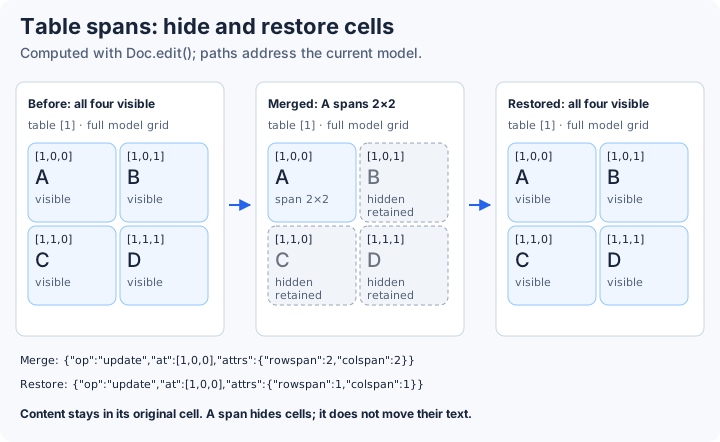
Update the top-left cell's rowspan and colspan. Set both to 1 to split its merge. spanned is an output flag for covered cells; do not set it directly. The full-grid model keeps every cell and its text while a cell is covered.
The diagram below is generated from actual doc.edit() results. Cell A spans the grid after the update at [1, 0, 0]. B, C, and D become hidden; their text stays in their own cells. Updating the span back to 1×1 shows all four cells again.
const doc = fresh();
doc.edit([
    {op: "insert", at: [1], content: [emptyTable(2, 2)]},
    {op: "insert", at: [1, 0, 0, 0, 0, 0], content: "left"},
    {op: "insert", at: [1, 0, 1, 0, 0, 0], content: "right"},
    {op: "update", at: [1, 0, 0], attrs: {rowspan: 2, colspan: 2}},
]);
assert.equal(cellModel(doc, 0, 0).attrs!.rowspan, 2);
assert.equal(cellModel(doc, 0, 0).attrs!.colspan, 2);
assert.deepEqual(tableModel(doc).children!.flatMap(row => row.children!).map(cell => cell.attrs?.spanned ?? false), [false, true, true, true]);
assert.deepEqual(cellModel(doc, 0, 1).children![0].children![0].runs, [{text: "right", marks: {}}]);
assert.deepEqual(cellModel(doc, 0, 0).children![0].children![0].runs, [{text: "left", marks: {}}]);

doc.edit([{op: "update", at: [1, 0, 0], attrs: {rowspan: 1, colspan: 1}}]);
assert.deepEqual(tableModel(doc).children!.flatMap(row => row.children!).map(cell => cell.attrs?.spanned ?? false), [false, false, false, false]);
assert.deepEqual(cellModel(doc, 0, 1).children![0].children![0].runs, [{text: "right", marks: {}}]);
Merging hides covered-cell text; it does not collect that text into the top-left cell. Splitting shows it again. The span uses end row/column IDs internally, so axes inserted within those endpoints join the span. Overlapping concurrent merges follow the existing deterministic winner rule.
Insert and update an inline node
An inline node occupies one text position. Insert its model JSON at that offset. An update at the same position, without length, changes its attributes.
const doc = fresh();
doc.edit([
    {op: "insert", at: [0, 0], content: "AB"},
    {op: "insert", at: [0, 1], content: [{type: "inline-image", attrs: {src: "https://example.com/image.png"}}]},
    {op: "update", at: [0, 1], attrs: {width: 320}},
]);
assert.deepEqual(doc.toJSON().children![0].runs, [
    {text: "A", marks: {}},
    {type: "inline-image", attrs: {src: "https://example.com/image.png", width: 320, height: 90}},
    {text: "B", marks: {}},
]);
The current text type must permit that inline type in children. The demo's full image component adds a separate flow and caption group. An inline image needs no such container. A text type with text: false can permit inline content while rejecting character input at the editor level.
Set links and formatting on a text range
Use update with a text position and length. Boolean marks such as bold and value marks such as link use the same operation. The schema's span displays adjacent characters with one URL as an inline-hyperlink. New input inherits bold but does not inherit link in this schema.
const doc = fresh();
doc.edit([
    {op: "insert", at: [0, 0], content: "Read"},
    {op: "update", at: [0, 0], length: 4, attrs: {bold: true, link: "https://example.com"}},
    {op: "insert", at: [0, 4], content: "!"},
]);
assert.deepEqual(doc.toJSON().children![0].runs, [
    {type: "inline-hyperlink", attrs: {url: "https://example.com"}, runs: [{text: "Read", marks: {bold: true}}]},
    {text: "!", marks: {bold: true}},
]);

doc.edit([{op: "update", at: [0, 0], length: 4, attrs: {link: null}}]);
assert.deepEqual(doc.toJSON().children![0].runs, [{text: "Read!", marks: {bold: true}}]);
A range targets the characters observed when the operation is created. Concurrent new characters are not added to its targets later. The URL pattern here permits HTTP and HTTPS. Set a value mark's inherit: true only if new input should inherit that mark.
Choose schema-valid edits
The application must choose types and attribute values allowed by its schema. In this example schema, a cell body permits paragraphs and lists, but not nested tables, callouts, or headings. level accepts 0–4; paragraph align accepts left, center, or right.
doc.edit() is an editing compiler. It applies locally without automatically calling Doc.check(). Do not assume an invalid request will be a no-op. The next example deliberately uses a disposable document to produce invalid edits. A separate receiving document checks the operations before applying them, as the server does.
const draft = fresh("draft");
const receiver = fresh("receiver");
const seed = draft.edit([{op: "insert", at: [1], content: [emptyTable(1, 1)]}]).ops;
assert.equal(receiver.check(seed), null);
seed.forEach(op => receiver.apply(op));
const before = receiver.toJSON();

const forbidden = draft.edit([{
    op: "insert", at: [1, 0, 0, 0, 1], content: [{type: "callout"}],
}]).ops;
assert.ok(forbidden.length > 0);
assert.equal(typeof receiver.check(forbidden), "string");
assert.deepEqual(receiver.toJSON(), before);

const invalidAttributes = fresh("invalid").edit([
    {op: "update", at: [0], attrs: {align: "sideways"}},
]).ops;
assert.equal(typeof fresh("validator").check(invalidAttributes), "string");
assert.deepEqual(schema.nodes["table-cell-body"].shape, "flow");
Server validation uses immutable membership and birth types. It does not enforce every constraint about a block's current type. For example, accepting text somewhere in a container does not prove that a hand-built operation targets a text-accepting current block. See the editing API reference for validation and normalization limits.
Concurrent Enter
Use split for Enter. Two independent splits at the same boundary create one new line. After a participant has received that split, another Enter can create a further line.
const alice = fresh("alice");
const bob = fresh("bob");
const seed = alice.edit([{op: "insert", at: [0, 0], content: "abcd"}]).ops;
seed.forEach(op => bob.apply(op));
const aliceEnter = alice.edit([{op: "split", at: [0, 2]}]).ops;
const bobEnter = bob.edit([{op: "split", at: [0, 2]}]).ops;
bobEnter.forEach(op => alice.apply(op));
aliceEnter.forEach(op => bob.apply(op));
assert.deepEqual(alice.toJSON(), bob.toJSON());
assert.deepEqual(alice.toJSON().children!.map(node => node.runs), [
    [{text: "ab", marks: {}}], [{text: "cd", marks: {}}],
]);

const laterEnter = alice.edit([{op: "split", at: [1, 0]}]).ops;
laterEnter.forEach(op => bob.apply(op));
assert.deepEqual(alice.toJSON(), bob.toJSON());
assert.deepEqual(alice.toJSON().children!.map(node => node.runs), [
    [{text: "ab", marks: {}}], [], [{text: "cd", marks: {}}],
]);
This checks operation exchange in memory. It does not test network delivery, reconnect, history pins, or real editor input. See synchronization and editor integration for those contracts.
Limits and optional command helpers
Use move for identity-preserving block placement; see model operations. A text split divides a text block. It does not split an arbitrary subtree. Cell merging retains hidden text. Flow childRules provide required-child and maximum-count projection. Attribute min and max remain numeric value bounds. See document rules and annotations.
The optional commands helpers wrap these same edit operations for keyboard actions and add checks such as permitted types and numeric clamping. They are not required to position or edit blocks. These examples do not establish actual OS IME support, product performance targets, or release readiness.
Rust experiment
Use typed operations when the SDK has no higher level block command. This example creates a callout and an image, moves the image into the callout body, and sends both changes to another actor. The body key is specific to the fixed Movement preset.
Use the native SDK crate setup to run this complete Rust program.
use doc_sync_native_sdk::{Document, EditOptions, Key, Op, Result, SchemaPreset, Ticket};

fn main() -> Result<()> {
    let mut doc = Document::new("blocks-author", SchemaPreset::Movement)?;
    let mut peer = Document::new("blocks-peer", SchemaPreset::Movement)?;
    let callout = doc.next_ticket()?;
    let image = Ticket {
        lamport: callout.lamport + 1,
        actor: doc.actor().into(),
    };
    let birth = doc.record(
        vec![
            Op::Node {
                id: callout.clone(),
                origin: Key::root().ticket()?,
                node_type: "callout".into(),
                boundary: String::new(),
                attrs: None,
            },
            Op::Node {
                id: image.clone(),
                origin: callout.clone(),
                node_type: "image".into(),
                boundary: String::new(),
                attrs: None,
            },
        ],
        EditOptions::default(),
        0.0,
    )?;
    peer.apply_remote(&birth.ops)?;
    let parent = Key::parse(format!("0@{}/body", Key::from_ticket(&callout).as_str()))?;
    let at = doc.next_ticket()?;
    let moved = doc.record(
        vec![Op::Move {
            at,
            target: image,
            parent: parent.ticket()?,
            after: None,
        }],
        EditOptions::default(),
        10.0,
    )?;
    peer.apply_remote(&moved.ops)?;
    let model = doc.model()?;
    assert_eq!(model, peer.model()?);
    let callout = model
        .children
        .iter()
        .find(|n| n.node_type == "callout")
        .unwrap();
    assert!(callout.children.iter().any(|n| n.node_type == "image"));
    Ok(())
}
This example uses one of six fixed SchemaPreset values. A separate runtime schema API accepts limited Document/Graphic descriptors and custom sparse-sheet fields. Live schema changes, the full doc.edit() compiler, WASM, Node, HTTP, MCP and editor bindings are not included.
Raw protocol probe and reference checks
The native v6 fixture maps stored blocks to paragraph, heading, divider, image, callout, table and list-item. It projects list groups, inline images and string-valued link spans. It retains full table cells when a span hides them. These are the pinned rules in experiments/rust-shadow/schema-move.json, not the example schema above: heading levels are 1–6, and cell bodies can contain the fixture's recursive block types.
This wire example moves the original paragraph and its Hi text into a callout. It changes placement without copying the text tokens.
Build the private executable with the commands in the Rust guide. Run the following command from the repository root. Each input line produces one JSON response.
experiments/rust-shadow/target/debug/doc-sync-rust-shadow <<'JSONL'
{"cmd":"new","replica":"A","actor":"A","schema":"movement-logical-storage:json-attrs:value-marks:v1","capabilities":["movement-logical-storage-v1"]}
{"cmd":"apply","replica":"A","schema":"movement-logical-storage:json-attrs:value-marks:v1","ops":[{"t":"text","id":{"lamport":1,"actor":"A"},"origin":{"lamport":0,"actor":"~root"},"units":[72,105]},{"t":"node","id":{"lamport":3,"actor":"A"},"origin":{"lamport":2,"actor":"A"},"type":"callout"}]}
{"cmd":"apply","replica":"A","schema":"movement-logical-storage:json-attrs:value-marks:v1","ops":[{"t":"move","at":{"lamport":4,"actor":"A"},"target":{"lamport":0,"actor":"~root"},"parent":{"lamport":0,"actor":"3@A/body"},"after":null}]}
{"cmd":"state","replica":"A"}
JSONL
The final model contains a callout with Hi in its body. The text keeps IDs 1@A and 2@A; state retains one move record. This checks native placement in the fixed fixture. TypeScript still compiles the public editing commands. Required-child rules, field-level attributes, arbitrary schemas and live transitions remain outside native support. See current native coverage.